
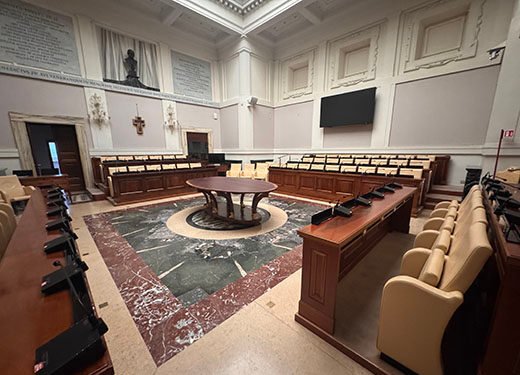
November 9 - Casina Pio IV – Vatican City
PreConference: a closed working meeting for a limited group of invited participants, held prior to the main conference
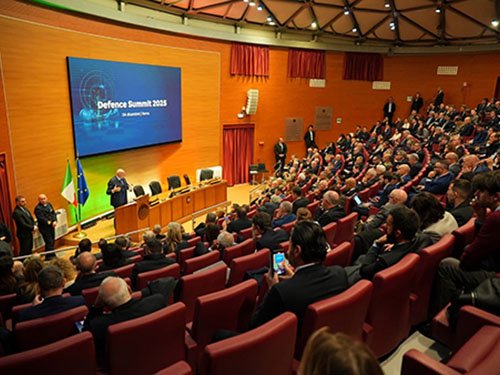
November 10/11– Centre of High Defense Study - Rome
Main Conference: these days are open to all participants and feature keynote talks, panels, and discussions
- 11:30 - 12:30
Preconference
11:30 – 12:00 Brunch
12:00 – 12:30 Welcome address
- 12:30 - 13:45
- Casina Pio IV
Session 1 – National Trauma System Needs in Italy
This session provides a critical appraisal of the current organization of trauma care in Italy, identifying structural, regulatory, and operational gaps that limit the effectiveness of trauma response. Speakers will explore the rationale for establishing a comprehensive national trauma system and how such a system could improve outcomes not only for trauma patients but also for other causes of life-threatening haemorrhage. Particular attention will be given to the disconnect between legislation and real-world implementation in trauma care and transfusion medicine, and to the enabling role of governance, data collection, and sustainable funding.
12:30 – 12:50 The need for national trauma system in Italy
12:50 – 13:10 How a national system can be developed in Italy
13:10 – 13:30 Regulatory and legislative Barriers to a national trauma system and Civ-Mil partnership
13:30 – 13:45 Discussion
- 14:00 - 15:20
- Casina Pio IV
Session 2 – International Trauma Systems: Challenges and Opportunities
The experience of developing regional and military trauma systems in the US and the UK will be described. Presentations will highlight key success factors, common barriers to implementation, and the role of continuous data collection and quality improvement. The session will also explore how structured civilian–military collaboration has contributed to trauma system evolution and how these lessons can inform European trauma system development.
14:00 – 14:20 US Civilian Trauma Systems
14:20 – 14:40 US Military Trauma System
14:40 – 15:05 London Trauma System
15:05 – 15:20 Discussion
- 15:35 - 16:55
- Casina Pio IV
Session 3 – Gap Analysis of the State of the Science
This session critically examines gaps between current scientific knowledge and clinical practice in the management of severe traumatic bleeding. Topics include the concept of “blood failure,” trauma-induced coagulopathy, and the emerging role of thromboinflammation in haemorrhagic shock. By identifying unresolved scientific questions and translational bottlenecks, the session sets the foundation for targeted innovation and more precise resuscitation strategies.
15:35 – 15:55 Trauma-Induced Blood Failure and Oxygen Debt
15:55 – 16:20 Trauma-Induced Coagulopathy (TIC): What It Is and What It Is Not
16:20 - 16:40 Thromboinflammation: The Headache the Morning After
16:40 - 16:55 Q&A
- 17:10 - 18:50
- Casina Pio IV
Session 4 – Solutions to Bridge the Gap to Achieve Precision Transfusion Medicine
Building on the identified scientific gaps, this session focuses on innovative solutions that enable precision approaches to haemostatic resuscitation. Presentations will address computational biology and digital twin models of trauma-induced coagulopathy, advances in haemostatic assays for real-time decision-making, and novel blood product concepts such as dried whole blood analogues. The session emphasizes how these tools can support individualized, timely, and resource-efficient transfusion strategies.
17:10 – 17:35 Hemostasis Assays: The Good, the Bad, and the Ugly
17:35 – 18:10 Dried Whole Blood Analogue: Is the Whole Greater Than the Sum of It’s Parts?
18:10 – 18:30 The Road to Precision Transfusion Medicine through Computational Biology and Digital Twins of TIC
18:30 – 18:40 Q&A
18:40 – 18:50 Closing remarks
- 09:30 - 11:00
- Palazzo Salviati - Auditorium
Session 1 – Hemostatic Resuscitation Principles
08:30 - 09:00 Registration
09:00 - 09:30 Welcome address
Effective haemostatic resuscitation requires integration of evidence-based transfusion and pharmaceutical strategies. This session discusses practical applications and ongoing controversies in optimizing blood and adjunct use for trauma patients.
9:30 – 9:55 Hemostatic Resuscitation Overview
9:55 – 10:20 Plasma, It is Not Just for Bleeding: Traumatic Brain Injury, Burn and Sepsis Resuscitation Too!
10:20 – 10:45 Role of Antifibrinolytics and Calcium: Optimal dosing, and potential for intramuscular dosing of TXA
10:45 – 11:00 Q&A
- 11:15-12:45
- Palazzo Salviati - Auditorium
Session 2 – Review of clinical trial data
This session summarizes key clinical trial findings that are shaping modern resuscitation paradigms.
This session provides a structured review of key clinical trials that are shaping contemporary resuscitation practice. Speakers will compare outcomes from trials evaluating prehospital whole blood, cold and frozen platelets, fibrinogen concentrates, prothrombin complex concentrates, and emerging therapeutic strategies. The session aims to translate trial evidence into clinical decision-making while highlighting remaining evidence gaps.
.
11:15 – 11:35 TOWAR and Swift-Prehospital Whole Blood Trials in Trauma
11:35 – 11:55 Cold and Frozen Platelet Trials (CRISP/CRISP-TBI/CLIP II/CRYPTICS
11:55 – 12:15 Fibrinogen and PCC Trials (TAP/CLOT/Cryostat-2)
12:15 – 12:30 Spitfire trial
12:30 – 12:45 Q&A
- 13:30-15:00
- Palazzo Salviati - Auditorium
Session 3 – Italy prehospital blood program and Special Populations
Implementing prehospital blood programs poses unique logistical and regulatory challenges. This session showcases Italy’s evolving program, lessons learned from international models, and strategies for maintaining quality and readiness.
The session also addresses the unique needs of special populations, including paediatric patients and postpartum haemorrhage.
13:30 – 13:50 Protocol Review for prehospital LTOWB in Italy, including data on the epidemiological situation in Italy
13:50 – 14:10 US based prehospital program: Quality Assurance and Training Requirements (DC Fire)
14:10 – 14:25 Pediatric Hemostatic Resuscitation
14:25 – 14:45 Treatment of Post-Partum Hemorrhage
14:45 – 15:00 Q&A
- 15:15-16:45
- Palazzo Salviati - Auditorium
Session 4 – Risks and Ethics of RDCR and DCR
Resuscitation and damage control strategies must be adapted to the unique physiological and ethical challenges of special populations. This session explores how remote damage control resuscitation (RDCR) and damage control resuscitation (DCR) principles can be safely and effectively applied to paediatric, geriatric, and non-trauma patients, as well as women of reproductive age. Ethical frameworks for allocating scarce resources in life-threatening bleeding are also discussed.
15:15 – 15:35 Risk Analysis of RhD+ products for Females of Childbearing Potential
15:35 – 15:50 Logistic hurdles of Rh-Neagtive and Group O Supply and How They Can Be Addressed (Rh- and Type O)
15:50 – 16:10 Alloimmunization Patient Perspective of RhD+ blood and HDFN Risk
16:10 – 16:30 Ethics of Resource Limited Products For Life Threatening Bleeding
16:30 – 16:45 Q&A
16:45-17:00 Closing remarks
- 09:00 - 10:30
- Palazzo Salviati - Auditorium
Session 1 – Military preparation for Large Scale combat Operation
The Innovation Summit marries CB Insights’ emerging trend research with the world's smartest minds - leading VCs. Planning is the very first step of organizing any event and Expro Events implement this stage efficiently and effectively. We always give a perfect touch to an event by finalizing a unique concept and then our specialists shape that concept into a remarkable structure.
9:00 – 9:25 Large Scale Combat Operations (LSCO): Expectations, Management, and the Potential for Autonomous Care
9:25 – 9:50 National Trauma System through Military and Civilian Partnerships to prepare for LSCO
9:50 – 10:15 Risk of nuclear warfare and medical treatment of acute radiation syndrome
10:15 -10:30 Q&A
- 10:45 - 13:15
- Palazzo Salviati - Auditorium
Session 2 – Regulatory architecture, oversight, and evidence - SoHO under pressure: blood & plasma supply, preparedness and emergency response
This high-level panel examines how the new EU Regulation on Substances of Human Origin (SoHO) can be implemented to ensure safety, quality, sufficiency, preparedness, and public trust, while at the same time enabling innovation and effective cross-border cooperation in trauma care, massive haemorrhage, and emergency response.
The discussion will address the implementation of the SoHO Regulation from regulatory, operational, and stakeholder perspectives, highlighting both challenges and opportunities in routine practice and crises. While grounded in the European framework, the panel will emphasize the broader relevance of the SoHO approach also for the international community, recognising that lessons learned in Europe can support global preparedness, humanitarian response, and the strengthening of trauma and transfusion systems worldwide.
10:45 – 11:00 Moderators Intro and panel structure
11:00 – 12:45 Panel Discussion
1.National Implementation and Regulatory Convergence, including Safety, Quality, and Risk-Based Regulation
2. Preparedness, Sufficiency, and Surge Capacity
3. Cross-Border Cooperation and Interoperability
4. Innovation Enablement and Evidence Generation
5. Walking Blood Banks and Non-Conventional Supply Models
12:45 – 12:55 Moderators wrap-up
12:55 – 13:05 Conference take-home messages
13:05 – 13:15 Closing remarks